By Timo Raus — October 31, 2023

Over the summer my wife and I moved within the Westland region. A lot more space for our dog and a place with even more history. It even has a traditional Westland-style fruit/grape-wall dating back to around 1875! It is now our cultural duty to take good care of this part of history. The fruit/grape-wall ended up in a restoration project and a brand-new hobby greenhouse has been built to preserve the property’s traditions.
We recently got handed down pictures of the property dating back to 1926 by previous owners. As a history lover and greenhouse fanatic, I simply couldn’t help myself: I dusted off my books and maps about the region to share a thing or two about how our greenhouse industry developed into the international frontrunner of high-tech horticulture it is today, by two different paths. This all based on pictures from my own backyard!
The Westland region in the Netherlands — where I was born, partially raised and currently live — has a rich history characterised by its pioneering spirit in food farming. Over the centuries, it has evolved to become a powerhouse in food farming, driven by continuous innovation and development, a hardworking ethos, and the adaptability to modify its conditions to suit agricultural needs.
Fruit/Grape Walls: Where It All Started
In the 19th century, there was a shift from livestock farming and agriculture to horticulture; traditional farms gradually made way for horticultural farms and orchards. This was driven by the growing demand for fruits and vegetables in the cities of The Hague and Delft, which were easily accessible by boats through the canals. To protect fruit trees and grapevines from strong sea winds, tall fruit/grape-walls varying between 2 and 2.5 meters were built. These walls, made of brick, not only provided protection but also retained solar heat, significantly advancing the ripening of crops. This allowed growers to bring their produce earlier to the market at a higher price! By 1878, there were almost 180 kilometers of these fruit/grape walls in the Westland region, especially in towns like Naaldwijk and Poeldijk — the latter still uses a grapevine in its emblem. Today, throughout the Westland region, out of the almost 180 km there is only 400 m left.
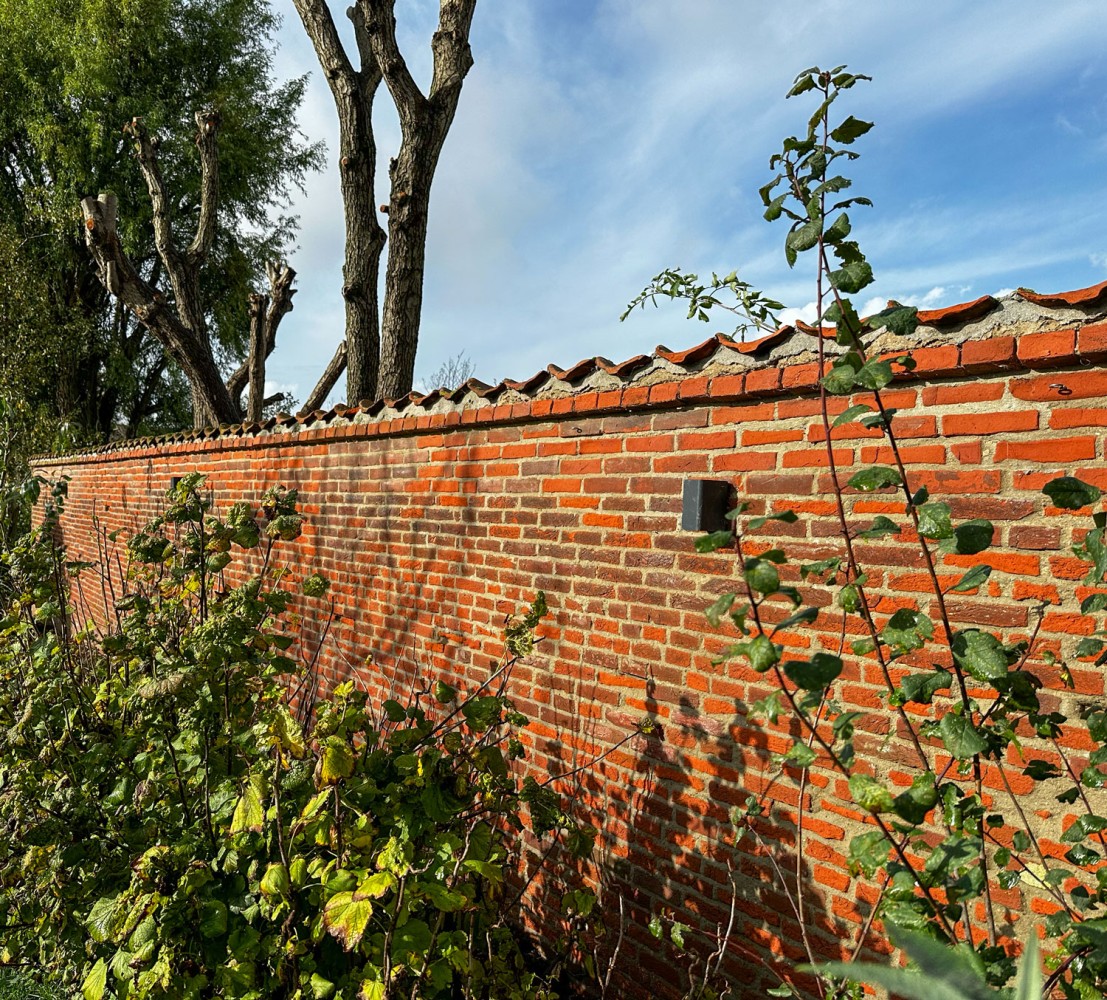
Interesting fact: During the restoration I discovered that the backbones and foundations of these walls were traditionally filled with rubble. My wall was filled with pieces of old bricks, broken porcelain, and broken glass — both from bottles and flat-glass, most likely from “shooting windows”.
In the late 19th century, driven by the ongoing Dutch growers’ quest to improve yields and profits, the first glass structures made their debut. These early versions were made by placing glass windows against the fruit walls, known as “shooting windows” — basically wooden window frames fitted with small glass panes. Although they reduced dependency on climatic conditions, these structures were cumbersome in terms of labor, expensive, and lacked ventilation. Quickly adapting, by around 1850 the first fixed glass structures, called wall-greenhouses, began to emerge. Despite their popularity — with over 22 kilometers of the 180 kilometers of grape/fruit walls covered in glass by 1878 — these wall greenhouses are now a very rare sight in Westland.
Progress didn’t stop there. The next major leap was the development of the glass “houses” or grape greenhouses. These were entirely made of glass, eliminating the need for walls. Inspired by Belgian designs, the first of these in Westland was built in Poeldijk in 1888. In 1912 there were about 60 hectares of these new “grape-greenhouses”. By 1939, these structures covered almost 645 hectares, becoming a defining feature of the Westland landscape and making it the “City of Glass”. The market was booming and grapes were even exported — an incredible phenomenon given that export of perishable fruits and vegetables was almost unheard of in the first half of the last century.
The market for Dutch-grown table grapes, however, came to an end during the Second World War. After that it was never picked up again, as Dutch cultivation became outcompeted by Southern European countries — strongly influenced by the innovations and developments in transportation during the war.
Flat-glass: The Ancestor of Dutch Greenhouses
Parallel to the innovations for the cultivation of grapes was the introduction of single-paned frames around the 1880s. These were primarily used for vegetable cultivation such as melons and beans. By the early 20th century, greenhouses made of these frames, known as “warehouses,” covered 420 hectares by 1939.
The early 20th century marked a renewed flourishing period for Westland, establishing it as a prime horticultural hub compared to other Dutch regions. By 1904, with its 134 hectares of flat-glass, Westland — along with nearby Delft and Rotterdam — stood head and shoulders above regions like North Holland, which had only 26 hectares. Just over two decades later, Westland’s under-glass vegetable and fruit cultivation accounted for approximately 75% of the entire Dutch glass surface area.
It is the flat-glass that ended up becoming the greenhouses as we know them today. The continuous challenge to have produce on the market required heating systems, better irrigation systems and on and on. To accommodate this, more space was needed and the double-flat-glass beds were raised. This eventually led to greenhouses people could walk in. Up until the early seventies, greenhouse construction companies were carpenters, and the heating-system providers were blacksmiths. The first climate computers were introduced in the late sixties and seventies by renowned companies we still know and work with today: Ridder, Priva and Hoogendoorn. Many companies supplying to under-glass cultivation also stood the test of time, such as Royal Brinkman, which started by selling rope to bundle asparagus back in 1885!
Conditions for the Industry to Develop
Several factors played into Westland’s rise as the number one horticultural region of the Netherlands. Its proximity to urban markets such as Delft and The Hague, combined with excellent waterway connections to further cities, proved very beneficial. The moderate coastal climate — mild winters and cool sunny summers — gave Westland farmers a competitive edge, allowing them to bring fresh produce to the market slightly earlier than their inland counterparts.
Beyond these geographical and climatic conditions, in my opinion the very essence of Westland’s success lay in the character of its people. A thesis dating back to 1933, written by A.A.A. Verbraeck, described the Westlanders as having an unparalleled work ethic, entrepreneurial spirit, and a keen desire for financial success.
Turning the Odds in Your Favor
Not all of Westland had naturally suitable soil for horticulture. While areas like ‘s-Gravenzande, Monster, and Naaldwijk had favorable sandy soils, others required significant modification. Large-scale sanding projects were initiated, with up to five million cubic meters of sand being transported to improve the land before 1950 — to bring this to scale, imagine the size of the island of Manhattan dug out or filled up by 60 m.
In their pursuit of fertile land and profitable cultivation, Westland’s growers resorted to organic fertilizers, using silt from ditches, pig manure, and even human waste from surrounding cities. This adaptability, while not completely unique to the Westland, demonstrates their relentless drive to create the best conditions for farming.
The journey of Westland from a traditional agricultural region to a horticultural powerhouse is a true testament to three core principles:
- Continuous Innovation: From fruit walls to sophisticated glass greenhouses, due to and despite market conditions, they kept innovating.
- Hardworking Mentality: The determination and work ethic of the Westlanders have been key to the region’s success.
- Adapting to Changing Conditions: Whether modifying the soil or changing farming techniques, the Westlanders never shied away from altering their environment to meet their horticultural needs.
Consult the Past to Foresee the Future
It was the first climate computer in the seventies that allowed greenhouses to become higher, and I’m certain it is again climate computers that will propel our industry forward in the mid and late twenties. Not this time by eliminating the manual opening of a ventilation window, but by eliminating a portion of the complex day-to-day tasks of both growers and workers through branches of AI such as machine learning and robotics. This will empower growers to focus on their niche produce, market demand, and the intangible parts of their added value.
Today, the greenhouse industry in the Westland stands under political and economic pressure, regardless of its global position as frontrunner in horticultural excellence. If we, as a region and as a greenhouse industry, stay close to the principles that brought us where we are today, I’m certain the challenges will be overcome, leading to new innovations in horticulture.
Fortunately, the principles of innovation, hard work, and adaptability still run through the veins of most men and women in the Dutch greenhouse industry — to create the Future of Food Farming together!
— Timo Raus